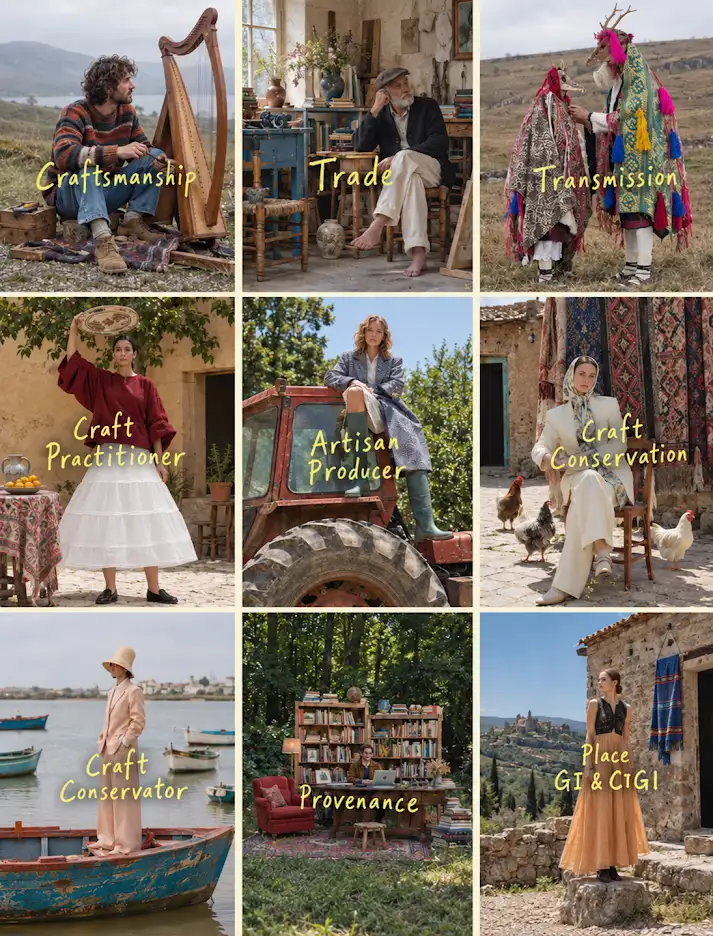
Precise terms prevent unlike things being treated as the same.
The framework distinguishes Craft, Craftsmanship, Craft as Trade, Craft Practitioners, Artisan Producers, Craft Conservators, transmission and provenance. It also separates practitioner identity, product records, craftsmanship assessment, geographical origin and cultural authority.
Definitions are operational tools for measurement, directories, policy and programs—not aesthetic judgements about what craft should look like.
Report basisMapping Australia’s Crafts Sector 2026 · Note on Terms; Sections 1.1–1.5.
SECTORAustralian Craft and Provenance Sector
The Australian Craft and Provenance Sector is a trade, industry, workforce and living-heritage sector constituted through Craft Practitioners, enterprises, workshops, institutions, materials, processes, products, markets and the transmission relationships that sustain them.
PRACTICECraft
Craft is the material practice of making, modifying, repairing or conserving tangible products through the handling, transformation, assembly or treatment of materials, ingredients or existing objects. The term also denotes the fields in which that practice occurs and the products that result. Those products may provide tangible manifestations of the knowledge and skills involved in their production.
QUALITYCraftsmanship
Craftsmanship is the demonstrable quality of making that arises when learned and embodied knowledge is applied through skilled human judgement at one or more consequential stages of making, modifying, repairing or conserving a product, including through the transformation, assembly or treatment of materials, ingredients or existing objects, such that the practitioner’s judgement materially affects the process or outcome.
ECONOMYCraft as Trade
Craft as Trade refers to skilled productive practice operating within economic and workforce systems through employment, enterprise, commission, production and exchange, in which material knowledge, technical capability and consequential human judgement contribute directly to productive activity.
CONTINUITYTransmission
Transmission is the process through which knowledge and skills are communicated, learned, embodied, renewed and passed between practitioners and across generations. It may occur through apprenticeship, teaching, observation, demonstration, supervised practice, oral instruction, documentation or participation in a community of practice.
PERSONCraft Practitioner
A Craft Practitioner is a person actively engaged in a field of craft. This may include making, modifying, repairing or conserving products; undertaking one or more consequential stages of production; or transmitting the knowledge and skills of a practice where that transmission is grounded in practical capability.
PRODUCTIONArtisan Producer
An Artisan Producer is an individual or enterprise engaged in small-scale production, within field-specific scale or volume limits, while retaining demonstrable practitioner involvement and control at one or more consequential stages of production.
SAFEGUARDCraft Conservation
Craft Conservation is the conservation, safeguarding and renewal of the tangible and intangible conditions through which craft capability is maintained and transmitted.
FUNCTIONCraft Conservator
Craft Conservator is a practitioner or conservation specialist whose work contributes to the continuity of craft capability through the conservation, restoration, repair, documentation, practice or transmission of craft knowledge, skills, processes and tangible manifestations.
EVIDENCEProvenance
Provenance is the documented and verifiable chain connecting a tangible product or object to its materials or ingredients, maker or producer, place and method of production; the lineage through which the knowledge and skills required to make it were acquired and transmitted; and its subsequent distribution, ownership, custody and use, together with its documented oral histories and cultural meanings. A provenance registry records these connections, their supporting evidence and any gaps, disputes or uncertainty.
IDENTIFIERMaker’s Mark & UPI
Within this report, a Maker’s Mark is a unique and permanent individual identifier assigned to a verified practitioner and applied to, or securely associated with, a tangible product, its packaging, accompanying documentation or provenance record. It links the product to the practitioner and attributes that practitioner’s contribution to its production. Where making is collaborative, a product may be associated with more than one Maker’s Mark. Within the proposed registry, each verified Craft Practitioner receives a Unique Provenance Identifier. The Maker’s Mark is the practitioner-facing expression of that identifier when it is applied to, or securely associated with, a product, its packaging, accompanying documentation or provenance record.
PLACEGI & CIGI
A Geographical Indication is a name or sign identifying a good as originating in a specific region where a given quality, reputation or other characteristic of the good is attributable to that geographical origin. Under the European Union system, a Craft and Industrial Geographical Indication (CIGI) is a public collective intellectual property right protecting the registered name of a craft or industrial product whose given quality, reputation or other characteristic is essentially attributable to its geographical origin. The right may be exercised by all eligible producers within the defined geographical area who comply with the applicable product specification.